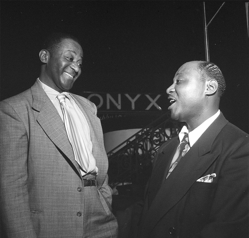
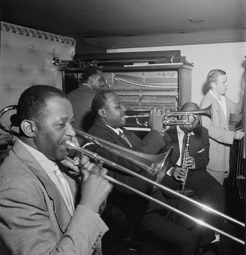

Wilbur deParis and Sidney deParis
1988 Garvin Bushell book

Excerpt from “Jazz From the Beginning”, Garvin Bushell as told to Mark Tucker. The University of Michigan Press, 1988, page 124 - 126
Jimmy Ryan’s is where I first joined Wilbur De Paris, in 1959. I replaced Omer Simeon, who had throat cancer and died soon after I went with Wilbur. (Omer Simeon died 17 September 1959).
I already knew the De Paris brothers. In those days you knew everybody: even if you didn’t play with them you knew them from the Rhythm Club. That’s the first place a black musician went when he came to town. If he was smart he’d introduce himself; if he was stupid he’d hang in the corner and wait ’til somebody asked him to play. He either made a good impression or a bad one.
At Ryan’s we did six hours a night, from 9:00 P.M. to 3:00 A.M., six nights a week. I was clearing ninety dollars a week, plus what I got from teaching. Wilbur was withholding all the money from Social Security and the union. But later I found out he didn’t pay it; when I applied for Social Security, I found out he hadn’t put any in for five years. Wilbur was a shrewd businessman. He died owing me about a thousand dollars.
I enjoyed Wilbur’s band because I got a chance to play clarinet. I had to bend my style a little bit and bring it closer to the old New Orleans way of playing. I was pleased with Sonny White’s piano, but I didn’t care for Wilbert Kirk’s drumming-Wilbur had him playing that boom-chank, boom-chank, two-to-the-bar, Leroy Smith style; Kirk was a better drummer than that. But it was a challenge memorizing all the arrangements. Nothing in that band was ever written down. It was the faking-est band for harmony I’d ever seen in my life!
The band was billed as playing “new” New Orleans jazz. It was an extension of the same concepts we had in the 1920s, but by now every- one was playing better technically. And our arrangements may have been more flexible than in the twenties. Wilbur was responsible for coming up with most of them. He was the boss from start to finish. He was a disciplinarian, but you could get along with him. His brother Sidney was his biggest problem; he was bullheaded, came in late, and always played sharp, on top of the pitch. But Wilbur couldn’t do much to change Sidney’s habits, because Sidney could take him in the back and whip him any day of the week.
The band always sounded better when Doc Cheatham was with us. Doc didn’t play with us at Ryan’s, but he joined us on the road and for recording dates. Doc was always on time, never any trouble. The world was a bowl of cherries, as far as Doc was concerned.
Around this time some changes were taking place in my personal life. Hilda and I started having problems and separated. Meanwhile I’d met a young woman, Louise Olivari, who had brought her daughter to the studio for clarinet lessons. Louise and I hit it off and began seeing one another quite a bit. Soon we were married.
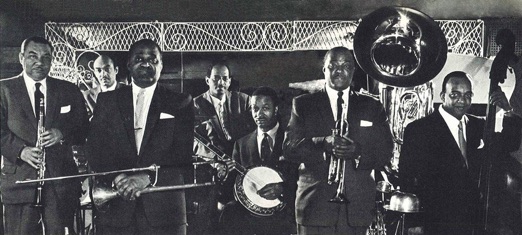
In 1960 I went with Wilbur’s band to Juan-les-Pins, France, for a jazz festival. Except for Doc Cheatham we had our regular Ryan’s lineup: Wilbur on trombone, his brother Sidney on trumpet, Sonny White on piano, John Smith on banjo and guitar, Hayes Alvis on bass, Wilbert Kirk on drums, and myself on clarinet. We stayed for two weeks and were received wonderfully. Charlie Mingus was on the same bill with us. On opening night, the audience booed Mingus because he was playing these long, repetitious numbers. The French weren’t used to his version of modern jazz. After he finished, Mingus went up to the microphone and said, “I’m sorry y’all don’t like what I play, but that’s the way I play and I don’t give a damn whether you like it or not!” There were 20,000 people in the audience booing him.
Eric Dolphy was with Mingus at the time. He was very intelligent, a high-class musician. He and I became good friends in Nice. Later, when we got back to New York, he played flute in my woodwind quintet. He could play good, legitimate flute. He was also a hell of a clarinet player, especially on bass clarinet.
I loved Eric Dolphy. When I met him I said to myself, “This is the guy I want to hang out with, the guy I want for a buddy.” We had a lot of things in common, but he had some more things I didn’t have. There was so much I could gain from him-his idea of finesse, for example-and he used to show me things on his horns. I don’t know of a musician I respected or admired more.
In Juan-les-Pins they were unveiling a monument to Sidney Bechet, and our band played and marched in the parade. We went through several small towns, and eventually had a huge crowd by the time we got to Sidney’s statue. I remember a woman asking me, “Are you a ce-leb-ri-ty?”
“You better believe it,” I said.
We played “Muskrat Ramble,” “Tiger Rag,” and various other jazz things. The French thought so much of Sidney. He was no doubt the biggest musician that had ever come from America.


Thanks to Bo Lindström for the excerpts.
We honour the great jazz personalities in the Wilbur deParis Band.
In order to understand the music, it is important that we also get to know the member´s private life and personality.
Such descriptions will never be objective.
In this article Garvin Bushell describes his time with Wilbur deParis.
Members of the Wilbur deParis band at a lunchbreak in Antibes 1960.


Wilbur DeParis And His "New" New Orleans Jazz
Sidney DeParis (cornet) Doc Cheatham (trumpet) Wilbur DeParis (trombone) Garvin Bushell (clarinet) Sonny White (piano, organ) John Smith (banjo, guitar) Hayes Alvis (bass) Wilbert Kirk (drums, harmonica) Louis Bacon (vocals)
See: 1960 Atlantic records.
Atlantic LP 1363, SD 1363 Wilbur DeParis On The Riviera